
By Eugenia Manolidou
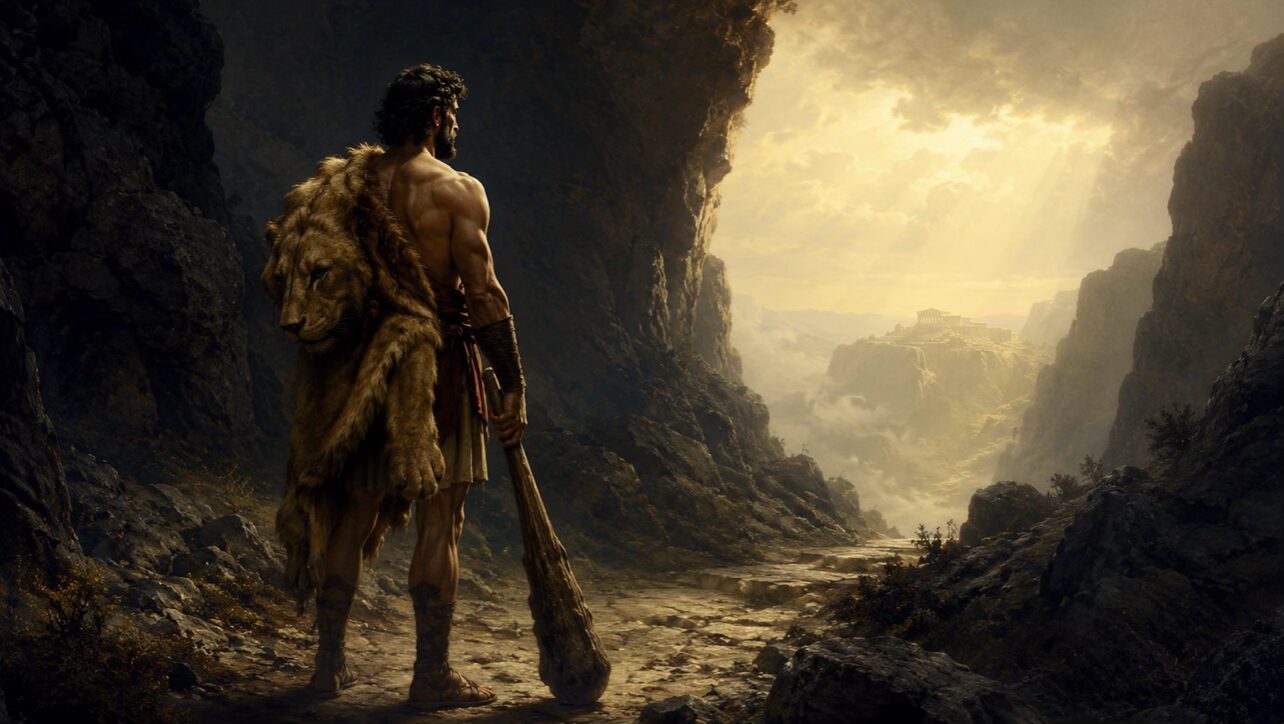
From gods and heroes to monsters and labours, Greek mythology has always offered humans a way to speak about themselves, with Heracles remaining the most recognisable figure of struggle, trial, and transcendence.
There is a precious inheritance that Greek civilisation gave us long before school textbooks, organised theories and scientific interpretations of the human being. Mythology. A world filled with gods, heroes, monsters, journeys, transformations, losses, trials, and returns. A world that seems to belong to childhood, because most of us encountered it very early, almost together with our first fairy tales. In reality, however, mythology is one of the deepest ways in which human beings tried to understand themselves, nature, fate, fear, pain, freedom, and the need for meaning in life.
Greek mythology was never a single book with a definitive form. It was an oral and literary tradition, a body of narratives about the gods, heroes, monsters, the beginnings of the world, and the relationship between human beings and the divine, the unknown. It was transmitted by word of mouth, passed into the epic poetry of Homer, into Hesiod’s Theogony, into theatre, vase painting, tragedy, historiography, local cult, Roman literature, and later into modern European art and thought. Ancient myths explained natural phenomena, social values, rituals, and moral dilemmas, while exercising an immense influence on the art and literature of the West.
Perhaps this is why mythology feels so familiar to us. It never introduces itself as foreign knowledge. It comes to us as memory. Even when we do not know the sources precisely, we recognise the figures: Zeus, Hera, Athena, Apollo, Odysseus, Achilles, Antigone, Medea, Oedipus, Prometheus, Heracles. These names inhabit our language, our images, our metaphors, the way we speak about the human condition. We say “labour” and mean something harder than a simple task. We say “Odyssey” and mean a long and painful journey. We say “Prometheus” and think of knowledge, progress, daring, and the price that must be paid.
There is, of course, an ancient interpretative tradition that seeks historical figures behind gods and heroes. Euhemerism, named after Euhemerus, argued that certain gods had once been great human beings who were honoured after death for their benefactions to humanity. This interpretation has its own charm, because it reveals a profound human need: to believe that behind the myth there once stood a person, an action, a memory so powerful that history raised it to the level of wonder.
And yet the truth of mythology is not exhausted by the historicity of its figures. Its power lies in the fact that it allows every age to recognise something of its own within it. Ancient drama drew almost inexhaustible material from myth and transformed it into theatre of thought, responsibility and judgement. Tragedy, from Aeschylus to Sophocles and Euripides, gave myths the form of a public confrontation with the limits of the human being, law, power, and divine order. Philosophical thought often used mythical examples to speak about virtue, choice, and education. Psychology, especially from Freud onwards, turned to figures such as Oedipus in order to describe deeper patterns of the human psyche, regardless of how we may assess those particular theories today.
Among all these figures, Heracles holds a special place. He is the hero everyone knows: the hero of strength, the club, the lion skin, the monsters and the Twelve Labours. Yet at the same time, he is a profoundly human hero. He is born into conflict, lives under the weight of divine hostility, makes mistakes, is punished, submits to a cycle of trials and is finally deified. Glory is not given to him freely. Heracles earns his place among the gods of Olympus through toil, pain, loss, patience, intelligence and perseverance.
In the famous tradition of “The Choice of Heracles,” attributed to Prodicus and preserved by Xenophon in the Memorabilia, the young Heracles stands at a crossroads before two female figures: Vice and Virtue. One promises him an easy life of pleasure, the other a difficult path, full of toil, honour and true glory. This episode became one of the most powerful moral examples of antiquity and of the later European tradition. Here Heracles ceases to be only a conqueror of beasts and becomes the human being called upon to choose what kind of life is worth living.
His labours can be read as great narratives of human trial. The Nemean Lion resembles the first confrontation with fear, with that raw and savage element that demands courage and inner endurance. The Lernaean Hydra recalls problems that multiply when we address them only superficially. The Ceryneian Hind teaches patience and respect before what is fragile and precious. The Augean Stables bring before us the need for radical cleansing, at the moment when accumulated neglect, injustice, or decay requires a new flow, a new way of thinking, a new beginning. The Apples of the Hesperides speak of the precious thing that lies far away, of knowledge that requires a journey, counsel, and sacrifice. Cerberus, at the end, brings the hero face to face with Hades, that is, with the most primordial human fear.
This is why Heracles still matters to us. His labours function as a memory of the obstacles that every human being is called upon to overcome in life. Fear, difficulty, doubt, exhaustion, the need to choose, the confrontation with the limits of the self all find in myth a timeless mode of expression. Often, without realising it, we call upon the very “weapons” that myth attributes to Heracles: strength, intelligence, endurance, the help of companions, faith in a purpose, and perseverance on the difficult path.
Here mythology functions as education. It teaches us without delivering a lesson. It moves us without needing to explain everything. It offers us forms, symbols, and words for what human beings experience in every age. This is also why we love myths so much as children. Before we even possess abstract thought, we understand the beast, the struggle, the fear, the victory, the injustice, the help, the journey. And as we grow older, the same myths grow with us. Where once we saw only a hero with a club, later we discern a human being who chooses, struggles, bends, rises and continues.
Heracles, then, does not need to be removed from our childhood imagination in order to acquire depth. Childhood imagination is often the first road towards depth. Through myth, the child learns to think in images. Through language, the child learns to give those images a name. Through education, the child learns to connect them with life. And through time, the child comes to understand that great myths do not grow old, because they touch something constant: the anxiety and the strength of the human being to become better.
Heracles remains alive because his labours belong to the way in which Greek civilisation learned to speak about effort, virtue, responsibility and transcendence. Every generation encounters him differently. Children through adventure. Adolescents through choice. Adults through the burdens, failures, decisions and confrontations of life. And all of us, in one way or another, recognise that somewhere within us there is a labour waiting to be completed.