
By Eugenia Manolidou
Two Homer lessons, two non-Greek teachers, and a reflection on what is lost when a language becomes trapped in ideological conflict.
Within a single week, I experienced two of the most moving moments of my educational journey. The first took place at the Accademia Vivarium Novum, where the Mexican scholar Gerardo Guzmán taught part of the Patrocleia, the section of the Iliad devoted to Patroclus. The lesson lasted an hour and a half and was conducted entirely in Ancient Greek, as are all language, literature, and philosophy classes at the Academy.
Among those present, the only Greeks were myself and my colleague from Elliniki Agogi, the school of Ancient Greek which I direct in Athens. Everyone else in the room was young: students and scholars from other countries, people who had travelled a considerable distance in order to reach something that we Greeks have so close to us: the Greek language in its historical continuity.
The way the text was read, the way each word was explained, the way the class entered into each scene, was profoundly moving. The Iliad was taught as a supreme work of art: with awe before its antiquity, but also with the emotional force that every great literary work possesses when one approaches it in the original, through the poet’s own rhythm and voice.
A few days later, I attended an online lesson on the Iliad offered by the Ancient Language Institute. The teacher, Vlad Chiurlea, of Romanian origin, taught lines from Book 3 of the poem, using alongside them the Greek paraphrase of Homer by Michael Psellos.
This comparison between Homeric Greek and an eleventh-century Byzantine Greek text opened before my eyes a remarkable landscape. I saw the same language travelling through the centuries, changing its rhythms, forms, and expressive needs, while preserving a recognisable inner kinship. Between Homer and Psellos, the continuity of a language of rare intellectual resilience became clear: a language that transforms itself, absorbs, renews, and survives, like a living mechanism of thought moving through time, almost like a modern algorithm.
And once again, I was the only Greek in the class.
I mention this not with bitterness, but with admiration, gratitude, and a certain inward unease. Two very young teachers, from two different countries, had devoted years of demanding study to our language, to the point where they could teach the Iliad from the original, in Ancient Greek, with accuracy, enthusiasm, and love. They did not have the advantage that we, as native speakers of Modern Greek, possess. They did not grow up hearing words, roots, structures, and expressions that still preserve older forms of the language within them. And yet they approached this world with perseverance and respect, while we Greeks often stand before it with hesitation.
That hesitation has a history. It does not arise only from strict or uninspiring teaching, nor simply from the fatigue caused by a difficult school subject. In Greece, the relationship with language became ideological very early on. The choice of words, the form of written expression, the attitude towards ancient, medieval, or demotic Greek were all charged with political meaning.
Even before the modern Greek state was established, during the period of the Modern Greek Enlightenment, there was already intense debate about which form of Greek could best serve education, thought, and public life. Three main tendencies emerged: those who supported a return to an archaic form of Greek, those who favoured a compromise between ancient and modern forms of the language, and those who defended the spoken vernacular.
This conflict entered education, administration, literature, the Church and everyday life. At times, it even acquired dramatic dimensions. In 1901, the so-called “Gospel riots” broke out in Athens over the translation of the Gospels into the vernacular, leading to violent clashes and deaths in the streets. Two years later, in 1903, the “Oresteia riots,” provoked by a performance of Aeschylus’ Oresteia in a modern Greek version, showed that the controversy was not only about religious language, but also about the way modern Greeks received their ancient inheritance.
Thus the Greek language, instead of functioning as a shared ground of education, became a field of ideological trial. The very medium of communication, intellectual cultivation, and international admiration became a field of division.
This long history left deeper traces than we often realise. The learned use of Greek was frequently associated with conservatism, affectation, authoritarianism, or social pretension. Archaic vocabulary became, in part of the collective imagination, a sign of eccentricity. Old Greek cinema often exploited this stereotype: the pedantic teacher speaking in pompous phrases, the ordinary man trying to give his speech false prestige by attaching ancient endings to words, language as comedy, as disguise, as social misunderstanding. These portrayals were often funny. But they also had consequences.
Gradually, a large part of Greek society learned to treat the older forms of the Greek language as something foreign to everyday life. At school, the distance grew. For many children, Ancient Greek became an exercise in deciphering, a field of grammatical forms without meaning, a system that demanded correct answers for good marks without offering the pleasure of understanding. Teaching often distanced children from the text instead of leading them towards it. And society, tired by old disputes, easily adopted the idea that all this was simply “unnecessary.”
There, I believe, lies our great mistake. When we distance ourselves from Ancient and Byzantine Greek, we do not lose access only to old texts. We also lose part of our contact with Modern Greek itself. We lose the depth of words we use every day, the ability to stand before inscriptions, monuments, and texts and feel that they concern us. We lose the sense that museums, the temples of the Muses, are not only settings of a dull educational excursion, but places of memory, language and meaning. We also lose contact with a literature that extends across centuries of Hellenism: from Homer to the Fathers of the Church, from learned Byzantine writing to folk song, modern literature and poetry.
Above all, we lose the inner calm offered by the pleasure of reading ancient texts. Anyone who has read even a few lines of Homer in the original, with proper guidance, knows that this is not an exercise in sterile antiquarianism, but a rare form of intellectual concentration. The word brings out the image, the figures come alive within the Greek landscape, the rhythm of the verse gives language movement, intensity and emotion. The ancient text, astonishingly relevant and enduring, reveals our own problems, our own anxieties, our own dilemmas.
Of course, one cannot ask a secondary-school student to confront prematurely the full depth of Homer. But a child can begin by hearing the language, recognising images, connecting words with actions, taking part in short dialogues, and approaching the text gradually and without fear.
This is why experiential teaching has such value, as do intermediary texts, paraphrases and linguistic bridges that lead the student from the familiar to the more demanding. The example of Psellos is particularly revealing: an eleventh-century Byzantine scholar approaches Homer through a Greek paraphrase, showing that access to the ancient text can pass through another form of the same language.
When Ancient Greek is taught only as a catalogue of rules, it remains distant from the student. When it is connected with voice, movement, image, dialogue, repetition, theatricality, narrative, and meaning, the student begins to feel, love, and admire it. The aim is not to simplify the subject to the point of impoverishing it, but to open pathways of access: from mechanical translation to meaningful understanding, from fear of error to the joy of participation, from the text as an exercise to the text as delight.
This is something I see increasingly outside of Greece. Young teachers, foreign institutions, summer academies, online programmes, groups of students and researchers are seeking ways to teach Greek and Latin experientially, as languages that are heard, read and used. What is often treated with suspicion in Greece, is gaining ground elsewhere as a serious pedagogical proposal.
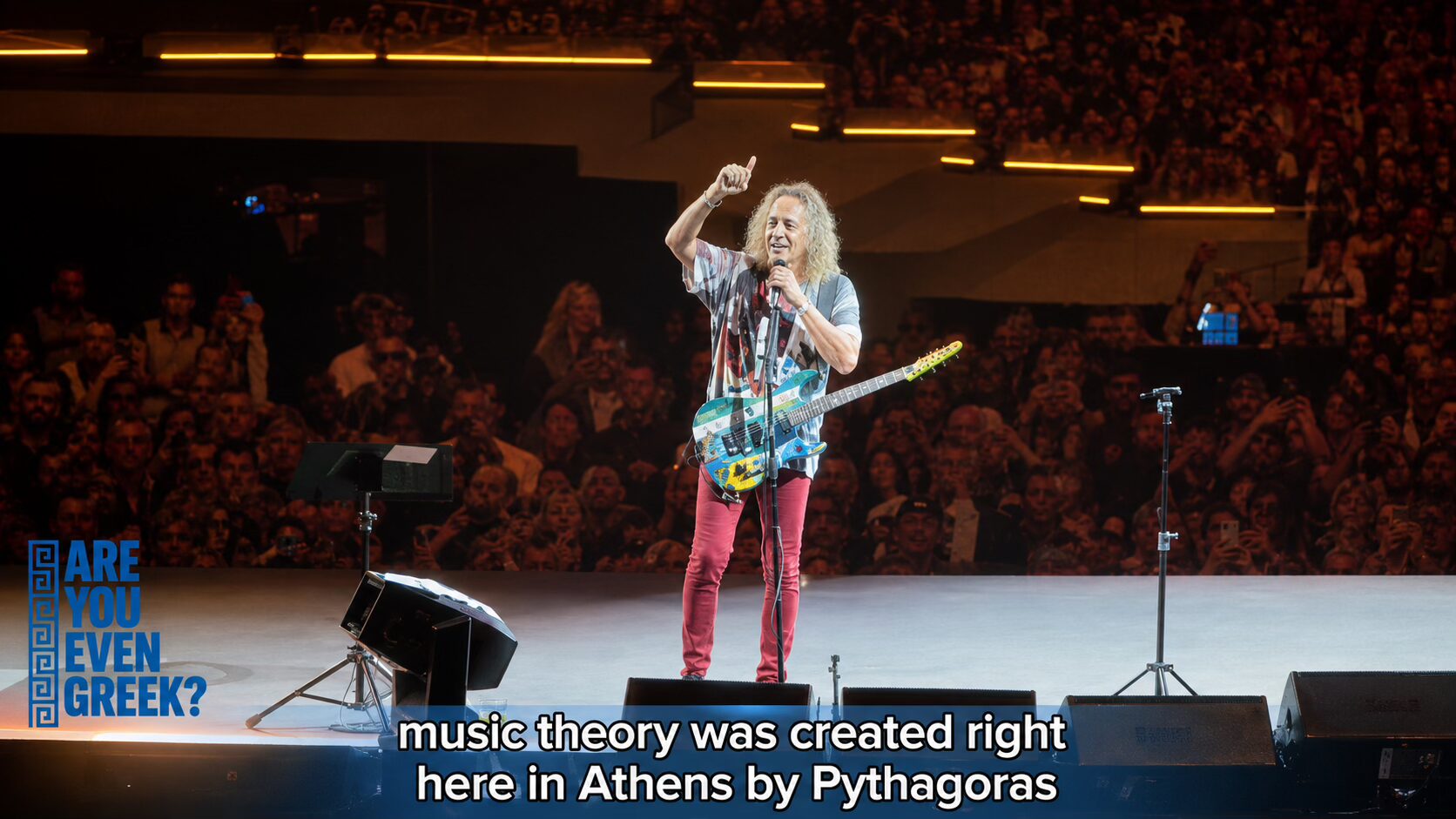
Here lies a paradox. When a Greek speaks about the value of the Greek language, he or she can easily be labelled old-fashioned, excessive, eccentric, or even ideologically suspect. When the same admiration is expressed by a non-Greek teacher, or even by a world-famous rock band honouring Greek musical references on stage before tens of thousands of people, it suddenly becomes news. The recent reference by Metallica at the Olympic Stadium in Athens to Pythagoras and the Greek musical tradition became a source of enthusiasm and pride, producing videos across social media, news headlines and thousands of admiring comments.
Perhaps it is time to release the Greek language from the old burdens placed upon it.
The Greek language does not belong to a political party, a faction, an ideology, or a nostalgic fantasy. It belongs to those who study it, speak it, write it, teach it, translate it and respect it. It is Greek and at the same time universal, because upon it were built great chapters of European thought, philosophy, science, theology, literature and art.
The point is not to return to old language wars. The point is to move beyond them. We need to show children that Modern Greek is not weakened by contact with Ancient Greek. It is illuminated by it. We need to show them that Ancient Greek is not dead simply because it is no one’s mother tongue in the modern sense. It is present in texts, words, concepts, monuments, inscriptions, thought and in the very layering of the Greek language itself.
And by learning it, we do not return to a forgotten past. We add another golden link to the long chain of a language that still thinks with us, advises us, accompanies us, and guides us.