
By Eugenia Manolidou
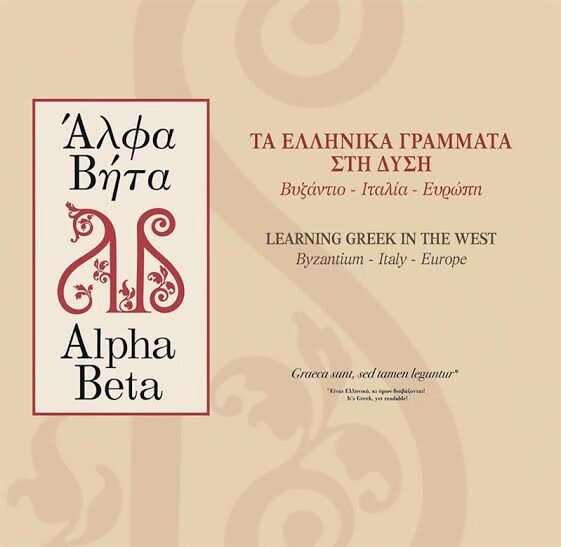
“It is Greek; it cannot be read.” With the phrase Graeca sunt, non leguntur, scribes and scholars of the Latin West once expressed their helplessness before Greek passages they encountered in manuscripts but could not decipher. The exhibition of the Hellenic Parliament, “Alpha Beta: Learning Greek in the West. Byzantium – Italy – Europe,” turns that old admission of difficulty into a brilliant reversal: Graeca sunt, sed tamen leguntur – “It is Greek, and yet it is read.” In that reversal lies one of the great adventures of European education: the Renaissance was born when Europe desired to read Greek texts again in the language in which they had been written.
The exhibition, presented in the Peristyle of the Hellenic Parliament, traces with scholarly precision and aesthetic refinement the journey of the Greek language from Byzantium to Italy and from there to the rest of Europe. It shows that the love for Greek civilization, which shaped European humanism, was founded above all on language. Homer, Plato, Aristotle, the tragedians, the historians, and the Fathers of the Church held immense authority in the West; true access to their works, however, passed through the study of Greek.
This longing is captured movingly by Petrarch, the great Italian scholar and poet of the fourteenth century, when he received a Greek manuscript of Homer and stood before it in awe, holding in his hands a treasure he longed to hear, while still lacking the language that would allow him to understand it. Homerus tuus apud me mutus, imo vero ego apud illum surdus sum, he wrote: “Your Homer is mute to me; or rather, I am deaf to him.” The phrase reveals the magnitude of the desire. Homer was there; the manuscript was there; the poet’s fame had crossed the centuries. Yet the distance of language kept the essence of the work closed.
At the turn of the fourteenth to the fifteenth century, Byzantine scholars, bearers of an unbroken philological tradition, met the Italian humanists and gave the West the means to approach again its own intellectual roots. Manuel Chrysoloras, who inaugurated the teaching of Greek letters in Florence in 1397, cultivated among his students the desire to know the texts in the original. Around this apprenticeship there formed circles of students, workshops of translation, libraries, schools, chairs of Greek, and an entire intellectual world in which the Greek language became an instrument of education, philological labour, theological reflection, political thought, and scientific inquiry.
Printing gave this movement historical force. In Venice, Aldus Manutius, with the collaboration of scholars such as Marcus Musurus, devoted himself to the publication of Greek texts and made ancient Greek literature accessible to a wider learned readership. His editions of Aristotle, Aristophanes, Plato, and many others were acts of cultural transmission. Through the printed book, the Greek language gained new circulation, new readers, and a new place in the European school and university.
Among the exhibits, one moment is especially moving. Students from the historic classical high school Marco Foscarini in Venice, the school once attended by Dionysios Solomos, brought to the Hellenic Parliament the books from which they study Ancient Greek today. It is worth remembering that Italy still has approximately 800 classical high schools. In that display case, one sees the power of education to unite generations separated by centuries. Petrarch, longing to hear Homer; the Byzantine scholars who taught Greek in the West; Solomos, who studied in Italy; and today’s students opening their Greek books in Venice all meet within the same spiritual time.
This is the essence of serious education: to connect what time has scattered. To bring together the manuscript and the schoolbook, the teacher and the pupil, Byzantium and Italy, Venice and Athens, Homer and the child today who tries to read a first sentence in Ancient Greek. From such encounters great intellectual movements are born. The Renaissance was precisely such a meeting of languages, texts, teachers, students, libraries, printing houses, and schools, through which Europe renewed its understanding of the human person and the world.
Here begins the responsibility of modern Greece. Where Petrarch stood “deaf” before Homer, modern Greeks stand in an incomparably more favourable position. Ancient Greek, with all its difficulty, density, and precision, is a high and demanding form of the same long linguistic continuity to which Modern Greek belongs. With systematic effort, proper guidance, and a method that begins from a living relationship with the word and the text, Greek students today can approach, with far greater ease, works that for centuries were objects of desire, labour, and admiration throughout Europe.
No translation, however faithful and conscientious, can fully transmit the rhythm, the memory, the inner tension, and the semantic wealth of the language in which a great text was written. This is true of every literary work. It is even more true of Greek literature, where word, thought, etymology, and cultural identity form an indivisible whole. Homer in translation is moving. Homer in the original is stunning.
For modern Greeks, this inherited privilege too often remains unused. Greek education must reconsider the method by which children are brought into contact with ancient Greek texts. Grammar and syntax have their proper place, but only within a teaching that leads the student from the word to the text, from the text to thought, from the familiarity of Modern Greek to the ancient root, from analysis to understanding, and from understanding to the joy of reading.
The exhibition of the Hellenic Parliament reminds us that Europe loved Greek civilization because it struggled to read it. Modern Greeks possess the invaluable privilege of approaching ancient texts through the continuity of their own language. The task is to make use of that privilege, so that children may acquire the method and the inner preparation to “hear” Homer, Aeschylus, Sophocles, Plato, and Aristotle again in the language in which some of humanity’s greatest masterpieces were written.
Warm congratulations are due to the Hellenic Parliament, the Library of the Hellenic Parliament, and all those who contributed to the exhibition, especially Sophia Hiniadou-Cambanis, for an initiative that honours the Greek language as a force of education, a bearer of memory, a bridge across the centuries, and a foundation of European intellectual identity.
The exhibition continues at the Hellenic Parliament until early September 2026.